PEMANFAATAN Trichorderma asperellum SEBAGAI PLANT GROWTH PROMOTING FUNGI (PGPF) PADA PERTUMBUHAN TANAMAN JAGUNG
DOI:
https://doi.org/10.59638/jai.v5i1.281Keywords:
Trichoderma asperellum, PGPF, jagung Anoman, hawar daun, pertumbuhan tanaman.Abstract
ABSTRAK
AHMAD ALI 20011014032. Pemanfaatan Trichoderma asperillum Sebagai Plant Growth Promoting Fungi (PGPF) terhadap Pertumbuhan Tanaman Jagung. Dibimbing oleh: A. ABD. RAHMAN SYAFAR dan SURYANI.
Penggunaan pupuk dan pestisida kimia berlebih pada budidaya jagung di Indonesia berpotensi merusak lingkungan, sehingga diperlukan agen hayati seperti Plant Growth Promoting Fungi (PGPF) Trichoderma asperellum untuk meningkatkan pertumbuhan dan ketahanan tanaman. Penelitian ini bertujuan mengetahui potensi T. asperellum strain CHM01, CHM02, HMRP7A, HMRP9A, dan HMRP10 sebagai pemacu pertumbuhan jagung varietas Anoman serta kemampuannya menekan penyakit hawar daun. Penelitian dilakukan di rumah kaca BPSIP-TS Maros Sulawesi Selatan pada Juli-Desember 2023 menggunakan Rancangan Acak Lengkap (RAL) dengan 7 perlakuan (5 strain T. asperellum, kontrol fungisida Nordox, dan kontrol aquades) yang diulang 4 kali, dianalisis dengan ANOVA dan uji Duncan ?=0,05. Hasil menunjukkan aplikasi T. asperellum berpengaruh nyata terhadap daya tumbuh (tertinggi 94,4% pada strain CHM02), pH tanah (tertinggi 6,153 pada HMRP10), suhu tanah (tertinggi 31,511°C pada HMRP10), dan intensitas serangan hawar (terendah 33,36% pada Nordox, 36-44% pada strain T. asperellum, vs 60,56% kontrol). Parameter vegetatif seperti tinggi tanaman (tertinggi 129,70 cm pada CHM02), diameter batang, dan ukuran daun cenderung lebih baik meski tidak nyata. Disimpulkan T. asperellum efektif sebagai PGPF untuk memacu pertumbuhan awal dan mengendalikan hawar daun jagung, direkomendasikan uji lapangan lanjutan.
Kata kunci: Trichoderma asperellum, PGPF, jagung Anoman, hawar daun, pertumbuhan tanaman.
Downloads
References
Abdelkhalek, A., Al-Askar, A. A., Arishi, A. A., and Behiry, S. I. (2022). Trichoderma hamatum strain Th23 mendorong pertumbuhan tomat dan menginduksi ketahanan sistemik terhadap virus mosaik tembakau. J. Fungi 8:228. doi: 10.3390/jof803022
Agbessenou, A., Akutse, K. S., Yusuf, A. A., and Khamis, F. M. (2022). The endophyte Trichoderma asperellum M2RT4 induces the systemic release of methyl salicylate and (Z)-jasmone in tomato plant affecting host location and herbivory of Tuta absoluta. Front. Plant Sci. 13:860309. doi: 10.3389/fpls.2022.860309
Agatha Erizta igathendi, Andi Soegianto, Arifin Noor Sugiharto. 2014. Karakterisasi Tujuh Genotip Jagung Manis (Zea mays saccharata Sturt.) Hibrida. Jurnal Produksi Tanaman Pangan. Volume 2, Nomor 8. Hlm 558-664
Andayani NN, Sunarti S, Azrai M, Praptana RH. 2014. Stabilitas Jagung Hibrida Silang Tuggal. Penel pert Tan Pangan. 33(3): 148-154.
Azizah, E., et. Al. 2017. Identifikasi Morfologi dan Jagung Hibrida Unpad pada tumpangsari dengan padi hitam didataran Tinggi Arjasari Jawa Barat. Jurnal Kultivasi. Vol. 16(1).
Azrai M, Kasim F, dan Hidayat JR. 2006. Stabilitas Hasil Jagung Hibrida. Penel Pert Tan Pangan. 25(3): 163-169.
Badan Pusat Satistik. (2021). Analisis Produktivitas Jagung dan Kedelai di Indonesia 2020 (hasil Survei Ubinan) (dan P. Direktorat Statistik Tanaman Pangan, Hortikultura (ed.) BPS-RI. https://www.bps.go.id/publication/
Bononi, L., Chiaramonte, J. B., Pansa, C. C., Moitinho, M. A., and Melo, I. S. (2020). Phosphorus-solubilizing Trichoderma spp. from Amazon soils improves soybean plant growth. Sci. Rep. 10:2858. doi: 10.1038/s41598-020-59793-82021/07/27/16e8f4b2ad77dd7de2e53ef2/analisis-produktivitas-jagung-dan-kedelai-di-indonesia-2020-hasil-survei-ubinan.html
Degani, O., Rabinovitz, O., Becher, P., Gordani, A., and Chen, A. (2021b). Trichoderma longibrachiatum and Trichoderma asperellum confer growth promotion and protection against late wilt disease in the field. J. Fungi 7:444. doi: 10.3390/jof7060444
Dibiya Nyoman, Suyarto R. 2017. Buidaya Jagung. Universiatas Udayana
Dongoran, D. 2009. Respons Pertumbuhan dan Produksi Jagunng Manis (Zea mays saccharata Sturt.) terhadap Pemberian Pupuk Cair TNF dan Pupuk Kandang Ayam. USU : Medan.
Endelman JB, Atlin GN, Beyene, Semagn K, Zhang X, Sorrels ME, Jannik JL. 2013. Optimal Design of Preliminary Yield Trials With Genome Wide Marker. Crop Science. 54(1): 48-59.
Gary J. Samuels, Elke Lieckfeldt, Helgard I. Nirenberg (1999): Trichoderma asperellum, a new species with warted conidia, and redescription of T. viride. – Sydowia – 51: 71 - 88.
Harman, G. E., Howell, C. R., Viterbo, A., Chet, I., & Lorito, M. (2004). Trichoderma species-opportunistic, avirulent plant symbionts. Nature Reviews Microbiology, 2(1), 43-56.
Howell, C. R. (2003). Mechanisms Employed by Trichoderma Species in the Biological Control of Plant Diseases: The History and Evolution of Current Concepts. Plant Disease, 87(1), 4–10. doi:10.1094/pdis.2003.87.1.4
Joo, J. H., and Hussein, K. A. (2022). Biological control and plant growth promotion properties of volatile organic compound-producing antagonistic Trichoderma spp. Front. Plant Sci. 13:897668. doi: 10.3389/fpls.2022.897668
Kakabouki, I., Tataridas, A., Mavroeidis, A., Kousta, A., Karydogianni, S., Zisi, C., et al. (2021). Effect of colonization of Trichoderma harzianum on growth development and CBD content of hemp (Cannabis sativa L.). Microorganisms 9:518. doi: 10.3390/microorganisms9030518
Karuppiah, V., Sun, J., Li, T., Vallikkannu, M., and Chen, J. (2019a). Co-cultivation of Trichoderma asperellum GDFS1009 and Bacillus amyloliquefaciens 1841 causes differential gene expression and improvement in the wheat growth and biocontrol activity. Front. Microbiol. 10:1068. doi: 10.3389/fmicb.2019.01068
Karuppiah, V., Vallikkannu, M., Li, T., and Chen, J. (2019b). Simultaneous and sequential based co-fermentations of Trichoderma asperellum GDFS1009 and Bacillus amyloliquefaciens 1841: a strategy to enhance the gene expression and metabolites to improve the bio-control and plant growth promoting activity. Microb. Cell Fact. 18:185. doi: 10.1186/s12934-019-1233-7
Lombardi, N., Caira, S., Troise, A.D., Scaloni, A., Vitaglione, P., Vinale, F., dkk. (2020a). Aplikasi Trichoderma pada tanaman stroberi memodulasi proses fisiologis yang secara positif mempengaruhi produksi dan kualitas buah. Depan. Microbiol. 11:1364. doi: 10.3389/fmicb.2020.01364
Mariyah Ulfa, Azwir Anhar, Violita, Vauzia, 2024. Growth of Trichoderma asperellum with the Addition of Paraffin to Corn-Based Medium. SERAMBI BIOLOGI Vol. 9 No. 1 pp. 23-30 2024
Marra, R., Lombardi, N., Piccolo, A., Bazghaleh, N., Prashar, P., Vandenberg, A., et al. (2021). Mineral biofortification and growth stimulation of lentil plants inoculated with Trichoderma strains and metabolites. Microorganisms 10:87. doi: 10.3390/microorganisms10010087
Martínez-Medina, A., Alguacil, M.D.M., Pascual, J.A., Wees, S.C.M.V., 2014. Phytohormone profiles induced by Trichoderma isolates correspond with their biocontrol and plant growth-promoting activity on melon plants. J. Chem. Ecol. 40 (7), 804–815
Minardi S., 2016. Optimalisasi Pengelolaan Lahan Kering Untk pengembangan Pertanian Tanaman Pangan. Library.uns.ac.id
Muhammed Ali Hossain., Fariha Tanjum Swarna., Fariha Tanjum., Swarna Rabeya., Islam Hamim., 2023. Trichoderma asperellum suppresses viral diseases and promotes the growth and yield of country bean. Frontiers. Frontiers | Trichoderma asperellum suppresses viral diseases and promotes the growth and yield of country bean
Nur A. Zin, Noor A. Badaluddin., 2020. Biological functions of Trichoderma spp. for agriculture applications. https://doi.org/10.1016/j.aoas.2020.09.003
Jumadi Oslan, Juanda Muhammad, caronge WM, Mu’nisa A, Iriany Neny.,2021. Teknologi Budidaya Tanman Jagung (Zea Mays) dan Sorgum (Soghum bicolor L). penerbitan Jurusan Biologi FMIPA UNM
Puti Maharani, Suryanti, Tri Joko, Susamto Somowiyarjo 2024. Rhizophagus intraradices dan Trichoderma asperellum sebagai Bioprotektan dan Biofertilizer pada Bawang Merah TSS. JIPI. Vol. 29 (2): 287-297
R. Vechithran1, Mayukh Sarkar1, Ranjna Kumari2, Paveen Prashant1 and Vipul Kumar1., 2025. Synergistic Application of Trichoderma asperellum and Biochar in Enhancing Cellulase Activity and Biocontrol Efficacy against Pythium aphanidermatum. Microbiol. 2025;19(3):1889-1902. https://doi.org/10.22207/JPAM.19.3.14
Rawal, R., Scheerens, J. C., Fenstemaker, S. M., Francis, D. M., Miller, S. A., and Benitez, M. S. (2022). Novel Trichoderma isolates alleviate water deficit stress in susceptible tomato genotypes. Front. Plant Sci. 13:869090. doi: 10.3389/fpls.2022.869090
Reza Putri1, Joko Prasetyo2, Tri Maryono2 dan Suskandini Ratih D2 (2022). Pengaruh Empat Isolat Trichoderma Spp. Terhadap Penyakit Bulai Dan Pertumbuhan Tanaman Jagung (Zea mays L.). Jurnal Agrotek Tropika, Mei 2022, Vol 10, No. 2, pp. 177 – 185. DOI : http://dx.doi.org/10.23960/jat.v10i2.5873
Siregar, R.S., Cik, Z. dan Saffrudin. 2018. Pengaruh Pemberian Dosis Trichoderma sp. Dan Jenis Pupuk Kandang Terhadap Pertumbuhan Dan Produksi Tanaman Kacang Panjang (Vigna sinensis L.). Journal Agricultural Research. 14(2) : 21-34.
Siska Syaranamual, Yaved Muyan1, Amelia S. Sarungallo. 2024. Uji Daya Kecambah Dan Uji Daya Tumbuh Benih Beberapa Tanaman Pangan: Suatu Pendekatan Untuk Hasil Berkelanjutan. Jurnal AGRI PEAT, Vol. 25 No. 1, Maret 2024: 1 - 8
Wang, H., Zhang, R., Duan, Y., Jiang, W., Chen, X., Shen, X., et al. (2021). The endophytic strain Trichoderma asperellum 6S-2: an efficient biocontrol agent against apple replant disease in China and a potential plant-growth-promoting fungus. J. Fungi 7:1050. doi: 10.3390/jof7121050
Whipps, J. M. (2001). Microbial interactions and biocontrol in the rhizosphere. Journal of Experimental Botany, 52(suppl 1), 487-511.
Xin Yao , Hailin Guo, Kaixuan Zhang, Mengyu Zhao1, Jingjun Ruan dan Jie Chen (2023). Trichoderma and its role in biological control of plant fungal and nematode disease. Front. Microbiol. https://doi.org/10.3389/fmicb.2023.1160551
Yukun Ma, Yetong Li, Shijia Yang, Yu Li and Zhaoxiang Zhu (2023). Biocontrol Potential of Trichoderma asperellum Strain 576 against Exserohilum turcicum in Zea mays. Jurnal of Fungi. doi: 10.3390/jof9090936
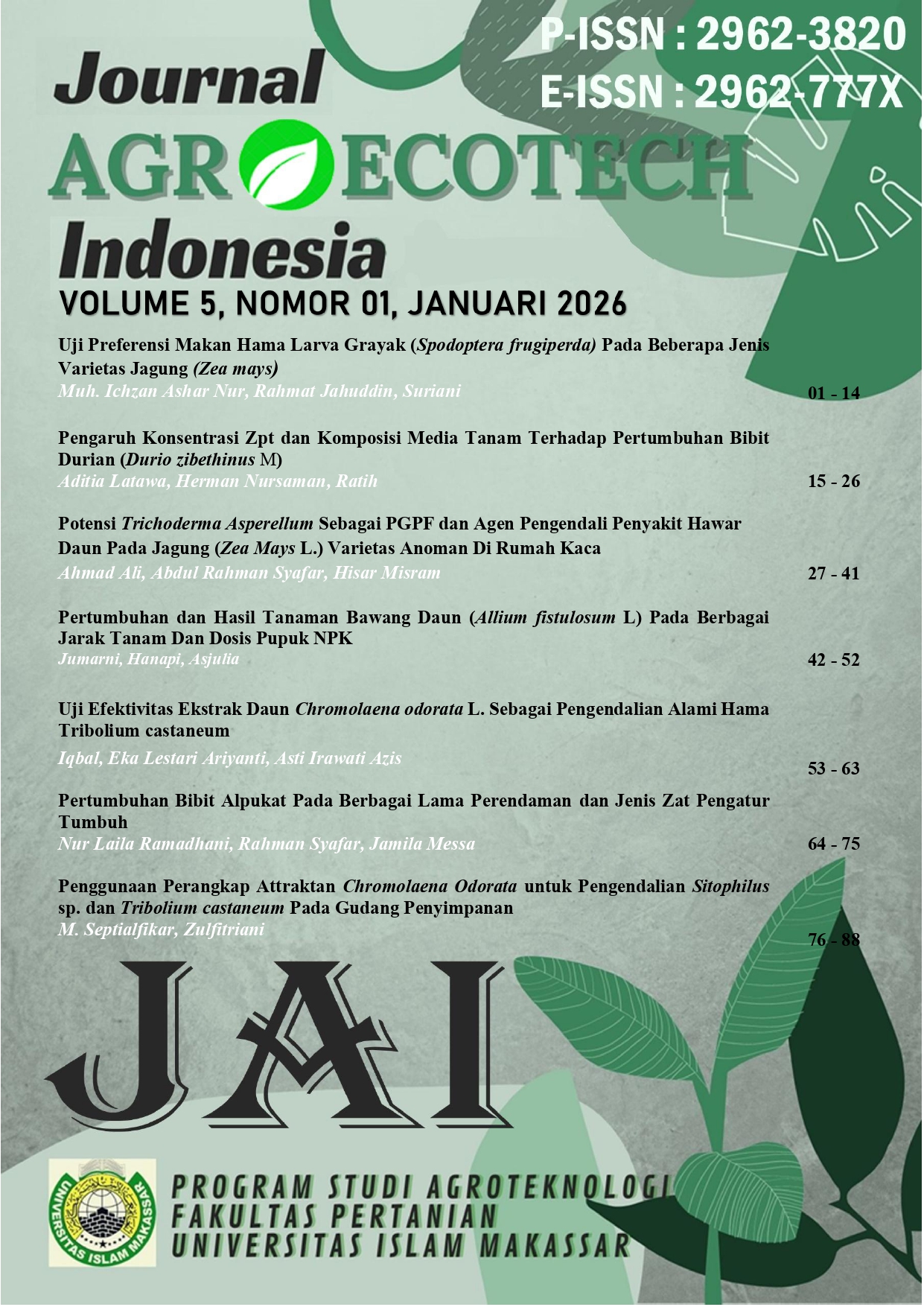
Downloads
Published
How to Cite
Issue
Section
License
Copyright (c) 2026 Journal Agroecotech Indonesia (JAI)

This work is licensed under a Creative Commons Attribution-NonCommercial 4.0 International License.